domingo, 17 de marzo de 2013
德
德 (radical 60 彳+12, 15 strokes, cangjie input 竹人十田心 (HOJWP), four-corner 24236)<
"Virtue", translated from Chinese de (德), is also an important concept in Chinese philosophy, particularly Daoism. De (Chinese: 德; pinyin: dé; Wade–Giles: te) originally meant normative "virtue" in the sense of "personal character; inner strength; integrity", but semantically changed to moral "virtue; kindness; morality". Note the semantic parallel for English virtue, with an archaic meaning of "inner potency; divine power" (as in "by virtue of") and a modern one of "moral excellence; goodness".
Confucian moral manifestations of "virtue" include ren ("humanity"), xiao ("filial piety"), and li ("proper behavior, performance of rituals"). In Confucianism, the notion of ren - according to Simon Leys - means "humanity" and "goodness". Ren originally had the archaic meaning in the Confucian Book of Poems of "virility", but progressively took on shades of ethical meaning. (On the origins and transformations of this concept see Lin Yu-sheng: "The evolution of the pre-Confucian meaning of jen and the Confucian concept of moral autonomy," Monumenta Serica, vol.31, 1974-75.)
The Daoist concept of De, however, is more subtle, pertaining to the "virtue" or ability that an individual realizes by following the Dao ("the Way"). One important normative value in much of Chinese thinking is that one's social status should result from the amount of virtue that one demonstrates, rather than from one's birth. In the Analects, Confucius explains de as follows: "He who exercises government by means of his virtue may be compared to the north polar star, which keeps its place and all the stars turn towards it."[


¿ya arrancaste tu compost?

Supercomposteras de jardin, ¿ya arrancaste tu compost?
pregunto : la descomposicion no seria mas rápida si se hiciera un pozo se tiran las hojas en el y se vuelve a tapar con tierra ? ademas de que nos se gastaria en ninguna estructura de alambres y madera , solo pala y ganas de trabajar un rato.
Lo del poso, solo se puede hacer en zonas de poca humedad, aca, en Bs As, no es aconsejable. Lo de las estructuras, tenes razón, pero también es como una forma de decorar el jardín, porque la verdad... no quedan mal
100 millones de toneladas de plásticos
Cada año, en todo el mundo, se producen 100 millones de toneladas de plásticos. Un 10% termina en el mar. Así es como ha llegado a formarse el llamado trash vortex (vórtice de basura), un área de 700 mil kilómetros cuadrados ubicada entre Estados Unidos y Japón, y que puede llegar a tener, en promedio 334.000 piezas de desechos por kilómetro cuadrado.
Esta masa inmensa de residuos fue descubierta en 1997 por el investigador Charles Moore cuando volvía de una competición a vela de Hawaii. "Cada vez que subía a cubierta para inspeccionar el horizonte, veía una botella de jabón, una tapa de la botella o un trozo de plástico flotando" contó por aquel entonces. "Aquí estaba yo en el medio del océano y no había ningún lugar al que pudiera ir que no tuviera plástico".
Fue él quien dio a conocer al mundo científico sobre los seis kilos de residuos plásticos que podían encontrarse en el Norte del Pacífico por cada kilo de placton, el alimento básico de muchos de los organismos marinos.
La también llamada sopa flotante cubre 800 kilómetros de la costa de California, rodea Hawaii, y llega casi hasta Japón. "Los plásticos absorben contaminantes y liberan químicos que van a parar al pescado que comemos", contó el científico Marcus Eriksen, del centro de investigación marino Algalita.
Esta institución, fundada por Charles Moore, realizó en 2008 un estudio en el que descubrió que de 671 peces que analizaron, el 35% estaban contaminados. Más allá del peligro que eso puede representar para el ser humano, también se han encontrado cadáveres de pájaros que tenían el estómago lleno de tapas de botellas de plástico, cepillos de dientes, restos de jeringuillas, y otros restos no biodegradables.
El problema, a juicio de Moore, es que la mayoría de los productos de plásticos se usan una sola vez, y no existe un buen modo de que vuelvan al consumidor para que sean reciclados, por lo que estos residuos pueden terminar en el mar. Este oceanógrafo ha explicado cómo las corrientes submarinas han provocado que a lo largo de los años se concentren en el norte del Pacífico unas 100 millones de toneladas de basura, o dicho de otro modo, el 2,5% de todos los productos de plástico que se han construido desde 1950.
No deja de ser llamativo que el 20% de los residuos vienen de las mismas embarcaciones marinas que surcan los mares mientras que tres de los países que generan parte de los desechos del norte del Pacífico son México, Australia y China, grandes consumidores y productores de residuos.
Debido a la salinidad de las aguas, la temperatura, y sobre todo la escasez de viento, en el Pacífico Norte se ha creado una zona en la que las corrientes marinas apenas tienen movimiento. Esta área se llama Giro del Pacífico Norte, y es el más grande de los cinco principales que existen en el planeta.
"Los vientos y las corrientes tienden a dirigir a la materia que flota en el agua hacia la zona central de baja energía del remolino", explica Greenpeace. Los trozos de plástico se degradan poco a poco con la luz del sol, se desintegran en minúsculos pedazos, y así terminan en el estómago de aves y de todo tipo de animales marinos. El daño que hacen al ecosistema marino es incalculable, aunque la ONU lanza algunas cifras: cada año, mueren un millón de aves y hasta 100.000 animales marinos por tratar de deglutir residuos plásticos.
Semejante extensión de basura podría ser muy impactante sólo a simple vista, pero el plástico es transparente y la mayor parte de los residuos están justo debajo de la superficie, así que las fotos por satélite no podrían mostrar el horizonte de desechos que cubre el norte del océano Pacífico.
Soluciones, por ahora, no hay ninguna. El impacto medioambiental es extraordinario, y las medidas para revertirlo deberían plantearse a largo plazo para ser sostenibles. Hay, no obstante, algunas iniciativas como la del Proyecto Kaisei, que estudia el detritus de los residuos para evaluar la posibilidad de transformarlos en algún tipo de combustible.
Esta institución, junto con otras organizaciones ecológicas, alertan del perjuicio medioambiental que conlleva la existencia de la isla de la basura, aunque no haya fotos impactantes, y aunque no se perciba desde tierra adentro. Éste es un riesgo real del que no está excluido el ser humano.
jueves, 10 de enero de 2013
改善
Kaizen (改善, "cambio a mejor" o "mejora" en japonés; el uso común de su traducción al castellano es "mejora continua" o "mejoramiento continuo")
En su contexto este artículo trata de Kaizen como una estrategia o metodología de calidad en la empresa y en el trabajo, tanto individual como colectivo. Kaizen es hoy una palabra muy relevante en varios idiomas, ya que se trata de la filosofía asociada al sistema de producción Toyota, empresa fabricante de vehículos de origen japonés.
Durante los años 1950, en Japón, la ocupación de las fuerzas militares estadounidenses trajo consigo expertos en métodos estadísticos de Control de calidad de procesos que estaban familiarizados con los programas de entrenamiento denominados TWI (Training Within Industry) cuyo propósito era proveer servicios de consultoría a las industrias relacionadas con la Guerra.
Los programas TWI durante la posguerra se convirtieron en instrucción a la industria civil japonesa, en lo referente a métodos de trabajo (control estadístico de procesos). Estos conocimientos metodológicos los impartieron W. Edwards Deming y Joseph M. Juran; y fueron muy fácilmente asimilados por los japoneses. Es así como se encontraron la inteligencia emocional de los orientales (la milenaria filosofía de superación), y la inteligencia racional de los occidentales y dieron lugar a lo que ahora se conoce como la estrategia de mejora de la calidad Kaizen. La aplicación de esta estrategia a su industria llevó al país a estar entre las principales economías del mundo.
Este concepto filosófico, elemento del acervo cultural del Japón, se lo lleva a la práctica y no sólo tiene por objeto que tanto la compañía como las personas que trabajan en ella se encuentren bien hoy, sino que la empresa es impulsada con herramientas organizativas para buscar siempre mejores resultados.
Partiendo del principio de que el tiempo es el mejor indicador aislado de competitividad, actúa en grado óptimo al reconocer y eliminar desperdicios en la empresa, sea en procesos productivos ya existentes o en fase de proyecto, de productos nuevos, del mantenimiento de máquinas o incluso de procedimientos administrativos.
Su metodología trae consigo resultados concretos, tanto cualitativos como cuantitativos, en un lapso relativamente corto y a un bajo costo (por lo tanto, aumenta el beneficio) apoyado en la sinergia que genera el trabajo en equipo de la estructura formada para alcanzar las metas establecidas por la dirección de la compañía.
Fue Kaoru Ishikawa el que retomó este concepto para definir como la mejora continua o Kaizen, se puede aplicar a los procesos, siempre y cuando se conozcan todas las variables del proceso.
Los caracteres originales para esta palabra son 改善 (pronunciado kaizen en japonés; gǎishàn en chino), donde:
改 (kai en japonés, gǎi en chino) significa 'cambio' o 'la acción de enmendar'.
善 (zen en japonés, shàn en chino) significa 'bueno' o 'beneficioso'.
Kaizen (改善?), Japanese for "improvement", or "change for the better" refers to philosophy or practices that focus upon continuous improvement of processes in manufacturing, engineering, and business management. It has been applied in healthcare,[1] psychotherapy,[2] life-coaching, government, banking, and other industries. When used in the business sense and applied to the workplace, kaizen refers to activities that continually improve all functions, and involves all employees from the CEO to the assembly line workers. It also applies to processes, such as purchasing and logistics, that cross organizational boundaries into the supply chain.[3] By improving standardized activities and processes, kaizen aims to eliminate waste (see lean manufacturing). Kaizen was first implemented in several Japanese businesses after the Second World War, influenced in part by American business and quality management teachers who visited the country. It has since spread throughout the world[4] and is now being implemented in many other venues besides just business and productivity.
The Japanese word "kaizen" simply means "improvement," with no inherent meaning of either "continuous" or "philosophy" in Japanese dictionaries or in everyday use. The word refers to any improvement, one-time or continuous, large or small, in the same sense as the mundane English word "improvement".[5] However, given the common practice in Japan of labeling industrial or business improvement techniques with the word "kaizen" (for lack of a specific Japanese word meaning "continuous improvement" or "philosophy of improvement"), especially in the case of oft-emulated practices spearheaded by Toyota, the word Kaizen in English is typically applied to measures for implementing continuous improvement, or even taken to mean a "Japanese philosophy" thereof. The discussion below focuses on such interpretations of the word, as frequently used in the context of modern management discussions.
Kaizen is a daily process, the purpose of which goes beyond simple productivity improvement. It is also a process that, when done correctly, humanizes the workplace, eliminates overly hard work ("muri"), and teaches people how to perform experiments on their work using the scientific method and how to learn to spot and eliminate waste in business processes. In all, the process suggests a humanized approach to workers and to increasing productivity: "The idea is to nurture the company's human resources as much as it is to praise and encourage participation in kaizen activities."[6] Successful implementation requires "the participation of workers in the improvement."[7] People at all levels of an organization participate in kaizen, from the CEO down to janitorial staff, as well as external stakeholders when applicable. The format for kaizen can be individual, suggestion system, small group, or large group. At Toyota, it is usually a local improvement within a workstation or local area and involves a small group in improving their own work environment and productivity. This group is often guided through the kaizen process by a line supervisor; sometimes this is the line supervisor's key role. Kaizen on a broad, cross-departmental scale in companies, generates total quality management, and frees human efforts through improving productivity using machines and computing power.[citation needed]
While kaizen (at Toyota) usually delivers small improvements, the culture of continual aligned small improvements and standardization yields large results in the form of compound productivity improvement. This philosophy differs from the "command and control" improvement programs of the mid-twentieth century. Kaizen methodology includes making changes and monitoring results, then adjusting. Large-scale pre-planning and extensive project scheduling are replaced by smaller experiments, which can be rapidly adapted as new improvements are suggested.[citation needed]
In modern usage, it is designed to address a particular issue over the course of a week and is referred to as a "kaizen blitz" or "kaizen event". These are limited in scope, and issues that arise from them are typically used in later blitzes.
After WWII, to help restore Japan, American occupation forces brought in American experts to help with the rebuilding of Japanese industry while The Civil Communications Section (CCS) developed a Management Training Program that taught statistical control methods as part of the overall material. This course was developed and taught by Homer Sarasohn and Charles Protzman in 1949-50. Sarasohn recommended W. Edwards Deming for further training in Statistical Methods.
The Economic and Scientific Section (ESS) group was also tasked with improving Japanese management skills and Edgar McVoy was instrumental in bringing Lowell Mellen to Japan to properly install the Training Within Industry (TWI) programs in 1951.
Prior to the arrival of Mellen in 1951, the ESS group had a training film to introduce the three TWI "J" programs (Job Instruction, Job Methods and Job Relations)---the film was titled "Improvement in 4 Steps" (Kaizen eno Yon Dankai). Thus the original introduction of "Kaizen" to Japan. For the pioneering, introduction, and implementation of Kaizen in Japan, the Emperor of Japan awarded the 2nd Order Medal of the Sacred Treasure to Dr. Deming in 1960. Consequently, the Union of Japanese Science and Engineering (JUSE) instituted the annual Deming Prizes for achievement in quality and dependability of products.
On October 18, 1989, JUSE awarded the Deming Prize to Florida Power & Light Co. (FPL), based in the US, for its exceptional accomplishments in process and quality control management. FPL was the first company outside Japan to win the Deming Prize.

The Toyota Production System is known for kaizen, where all line personnel are expected to stop their moving production line in case of any abnormality and, along with their supervisor, suggest an improvement to resolve the abnormality which may initiate a kaizen.
The cycle of kaizen activity can be defined as:
Standardize an operation and activities.
Measure the operation (find cycle time and amount of in-process inventory)
Gauge measurements against requirements
Innovate to meet requirements and increase productivity
Standardize the new, improved operations
Continue cycle ad infinitum
This is also known as the Shewhart cycle, Deming cycle, or PDCA. Other techniques used in conjunction with PDCA include 5 Whys, which is a form of root cause analysis in which the user asks "why" to a problem and finds an answer five successive times. There are normally a series of root causes stemming from one problem,[10] and they can be visualized using fishbone diagrams or tables.
Masaaki Imai made the term famous in his book Kaizen: The Key to Japan's Competitive Success.[11]
Apart from business applications of the method, both Anthony Robbins[citation needed] and Robert Maurer have popularized the kaizen principles into personal development principles. In the book One Small Step Can Change Your life: The Kaizen Way, and CD set The Kaizen Way to Success, Maurer looks at how individuals can take a kaizen approach in both their personal and professional lives.[12][13]
In the Toyota Way Fieldbook, Liker and Meier discuss the kaizen blitz and kaizen burst (or kaizen event) approaches to continuous improvement. A kaizen blitz, or rapid improvement, is a focused activity on a particular process or activity. The basic concept is to identify and quickly remove waste. Another approach is that of the kaizen burst, a specific kaizen activity on a particular process in the value stream
En su contexto este artículo trata de Kaizen como una estrategia o metodología de calidad en la empresa y en el trabajo, tanto individual como colectivo. Kaizen es hoy una palabra muy relevante en varios idiomas, ya que se trata de la filosofía asociada al sistema de producción Toyota, empresa fabricante de vehículos de origen japonés.
Durante los años 1950, en Japón, la ocupación de las fuerzas militares estadounidenses trajo consigo expertos en métodos estadísticos de Control de calidad de procesos que estaban familiarizados con los programas de entrenamiento denominados TWI (Training Within Industry) cuyo propósito era proveer servicios de consultoría a las industrias relacionadas con la Guerra.
Los programas TWI durante la posguerra se convirtieron en instrucción a la industria civil japonesa, en lo referente a métodos de trabajo (control estadístico de procesos). Estos conocimientos metodológicos los impartieron W. Edwards Deming y Joseph M. Juran; y fueron muy fácilmente asimilados por los japoneses. Es así como se encontraron la inteligencia emocional de los orientales (la milenaria filosofía de superación), y la inteligencia racional de los occidentales y dieron lugar a lo que ahora se conoce como la estrategia de mejora de la calidad Kaizen. La aplicación de esta estrategia a su industria llevó al país a estar entre las principales economías del mundo.
Este concepto filosófico, elemento del acervo cultural del Japón, se lo lleva a la práctica y no sólo tiene por objeto que tanto la compañía como las personas que trabajan en ella se encuentren bien hoy, sino que la empresa es impulsada con herramientas organizativas para buscar siempre mejores resultados.
Partiendo del principio de que el tiempo es el mejor indicador aislado de competitividad, actúa en grado óptimo al reconocer y eliminar desperdicios en la empresa, sea en procesos productivos ya existentes o en fase de proyecto, de productos nuevos, del mantenimiento de máquinas o incluso de procedimientos administrativos.
Su metodología trae consigo resultados concretos, tanto cualitativos como cuantitativos, en un lapso relativamente corto y a un bajo costo (por lo tanto, aumenta el beneficio) apoyado en la sinergia que genera el trabajo en equipo de la estructura formada para alcanzar las metas establecidas por la dirección de la compañía.
Fue Kaoru Ishikawa el que retomó este concepto para definir como la mejora continua o Kaizen, se puede aplicar a los procesos, siempre y cuando se conozcan todas las variables del proceso.
Los caracteres originales para esta palabra son 改善 (pronunciado kaizen en japonés; gǎishàn en chino), donde:
改 (kai en japonés, gǎi en chino) significa 'cambio' o 'la acción de enmendar'.
善 (zen en japonés, shàn en chino) significa 'bueno' o 'beneficioso'.
Kaizen (改善?), Japanese for "improvement", or "change for the better" refers to philosophy or practices that focus upon continuous improvement of processes in manufacturing, engineering, and business management. It has been applied in healthcare,[1] psychotherapy,[2] life-coaching, government, banking, and other industries. When used in the business sense and applied to the workplace, kaizen refers to activities that continually improve all functions, and involves all employees from the CEO to the assembly line workers. It also applies to processes, such as purchasing and logistics, that cross organizational boundaries into the supply chain.[3] By improving standardized activities and processes, kaizen aims to eliminate waste (see lean manufacturing). Kaizen was first implemented in several Japanese businesses after the Second World War, influenced in part by American business and quality management teachers who visited the country. It has since spread throughout the world[4] and is now being implemented in many other venues besides just business and productivity.
The Japanese word "kaizen" simply means "improvement," with no inherent meaning of either "continuous" or "philosophy" in Japanese dictionaries or in everyday use. The word refers to any improvement, one-time or continuous, large or small, in the same sense as the mundane English word "improvement".[5] However, given the common practice in Japan of labeling industrial or business improvement techniques with the word "kaizen" (for lack of a specific Japanese word meaning "continuous improvement" or "philosophy of improvement"), especially in the case of oft-emulated practices spearheaded by Toyota, the word Kaizen in English is typically applied to measures for implementing continuous improvement, or even taken to mean a "Japanese philosophy" thereof. The discussion below focuses on such interpretations of the word, as frequently used in the context of modern management discussions.
Kaizen is a daily process, the purpose of which goes beyond simple productivity improvement. It is also a process that, when done correctly, humanizes the workplace, eliminates overly hard work ("muri"), and teaches people how to perform experiments on their work using the scientific method and how to learn to spot and eliminate waste in business processes. In all, the process suggests a humanized approach to workers and to increasing productivity: "The idea is to nurture the company's human resources as much as it is to praise and encourage participation in kaizen activities."[6] Successful implementation requires "the participation of workers in the improvement."[7] People at all levels of an organization participate in kaizen, from the CEO down to janitorial staff, as well as external stakeholders when applicable. The format for kaizen can be individual, suggestion system, small group, or large group. At Toyota, it is usually a local improvement within a workstation or local area and involves a small group in improving their own work environment and productivity. This group is often guided through the kaizen process by a line supervisor; sometimes this is the line supervisor's key role. Kaizen on a broad, cross-departmental scale in companies, generates total quality management, and frees human efforts through improving productivity using machines and computing power.[citation needed]
While kaizen (at Toyota) usually delivers small improvements, the culture of continual aligned small improvements and standardization yields large results in the form of compound productivity improvement. This philosophy differs from the "command and control" improvement programs of the mid-twentieth century. Kaizen methodology includes making changes and monitoring results, then adjusting. Large-scale pre-planning and extensive project scheduling are replaced by smaller experiments, which can be rapidly adapted as new improvements are suggested.[citation needed]
In modern usage, it is designed to address a particular issue over the course of a week and is referred to as a "kaizen blitz" or "kaizen event". These are limited in scope, and issues that arise from them are typically used in later blitzes.
After WWII, to help restore Japan, American occupation forces brought in American experts to help with the rebuilding of Japanese industry while The Civil Communications Section (CCS) developed a Management Training Program that taught statistical control methods as part of the overall material. This course was developed and taught by Homer Sarasohn and Charles Protzman in 1949-50. Sarasohn recommended W. Edwards Deming for further training in Statistical Methods.
The Economic and Scientific Section (ESS) group was also tasked with improving Japanese management skills and Edgar McVoy was instrumental in bringing Lowell Mellen to Japan to properly install the Training Within Industry (TWI) programs in 1951.
Prior to the arrival of Mellen in 1951, the ESS group had a training film to introduce the three TWI "J" programs (Job Instruction, Job Methods and Job Relations)---the film was titled "Improvement in 4 Steps" (Kaizen eno Yon Dankai). Thus the original introduction of "Kaizen" to Japan. For the pioneering, introduction, and implementation of Kaizen in Japan, the Emperor of Japan awarded the 2nd Order Medal of the Sacred Treasure to Dr. Deming in 1960. Consequently, the Union of Japanese Science and Engineering (JUSE) instituted the annual Deming Prizes for achievement in quality and dependability of products.
On October 18, 1989, JUSE awarded the Deming Prize to Florida Power & Light Co. (FPL), based in the US, for its exceptional accomplishments in process and quality control management. FPL was the first company outside Japan to win the Deming Prize.
The Toyota Production System is known for kaizen, where all line personnel are expected to stop their moving production line in case of any abnormality and, along with their supervisor, suggest an improvement to resolve the abnormality which may initiate a kaizen.
The cycle of kaizen activity can be defined as:
Standardize an operation and activities.
Measure the operation (find cycle time and amount of in-process inventory)
Gauge measurements against requirements
Innovate to meet requirements and increase productivity
Standardize the new, improved operations
Continue cycle ad infinitum
This is also known as the Shewhart cycle, Deming cycle, or PDCA. Other techniques used in conjunction with PDCA include 5 Whys, which is a form of root cause analysis in which the user asks "why" to a problem and finds an answer five successive times. There are normally a series of root causes stemming from one problem,[10] and they can be visualized using fishbone diagrams or tables.
Masaaki Imai made the term famous in his book Kaizen: The Key to Japan's Competitive Success.[11]
Apart from business applications of the method, both Anthony Robbins[citation needed] and Robert Maurer have popularized the kaizen principles into personal development principles. In the book One Small Step Can Change Your life: The Kaizen Way, and CD set The Kaizen Way to Success, Maurer looks at how individuals can take a kaizen approach in both their personal and professional lives.[12][13]
In the Toyota Way Fieldbook, Liker and Meier discuss the kaizen blitz and kaizen burst (or kaizen event) approaches to continuous improvement. A kaizen blitz, or rapid improvement, is a focused activity on a particular process or activity. The basic concept is to identify and quickly remove waste. Another approach is that of the kaizen burst, a specific kaizen activity on a particular process in the value stream
domingo, 6 de enero de 2013
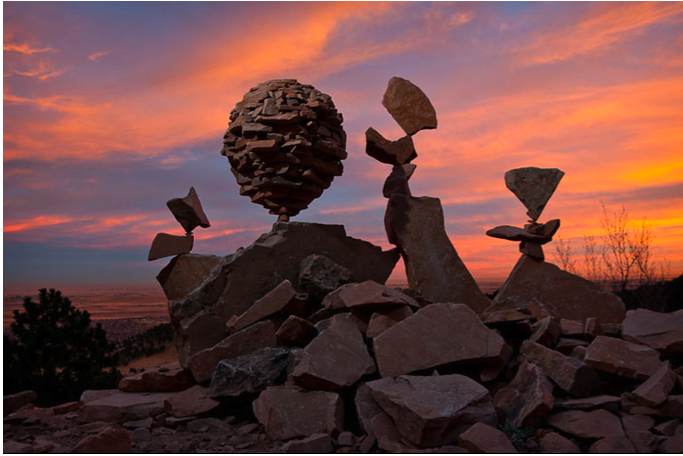
become the balance
Published on Jul 28, 2012
Rock Balance Demonstration by Michael Grab July 2012
The challenge here was making this balance happen within the 5 minute video limitation of my camera... it took about 5 takes to finally get it (AFTER getting to know the rocks).
*FOCUS. Relax. the coolest thing is that the camera was able to capture the creation AND natural collapse of the balance before the 5 minute limit. completing the cycle. :)) so here's how it's done.
*notice the technique of bracing the lower rocks while placing the next. the top rock acts as a pin to stabilize the whole structure, which is why it is very helpful to use a LARGE rock on top. plus, i like the overall design balance that the large top rock adds. and i love shades of red. as soon as i found that red rock, i knew it must go on top. it was a beautiful rock. :) contemplate, try it for yourself. all about presence in the moment. SLOW down. become the balance. :)
jueves, 3 de enero de 2013
D.T. Suzuki
Poisoned Pen Letters? D.T. Suzuki’s Communication of Zen to the West
By Dharmachāri Nāgapriya
Introduction
Daisetsu Teitarō Suzuki (1870-1966) has been widely celebrated as the first transmitter of Japanese Zen to the ‘West’i, especially the USA and Great Britain.ii In the course of his long life, he published dozens of books that practically defined the meaning of Zen for western audiences. In recent decades, however, the shine on Suzuki’s reputation has been somewhat worn off by some heavy criticisms.
Dukkha
Dukkha (Pāli; Sanskrit: duḥkha; Tibetan phonetic: dukngal) is a Buddhist term commonly translated as "suffering", "stress", "anxiety", or "dissatisfaction". Dukkha is identified as the first of the Four Noble Truths.
The early Western translators of Buddhist texts (prior to the 1970s) translated the Pali term dukkha as "suffering" and conveyed the impression that Buddhism was a pessimistic or world-denying philosophy. Later translators, however, including Walpola Rahula (What Buddha Taught, 1974) and nearly all contemporary translators, have emphasized that "suffering" is too limited a translation for the term dukkha, and have preferred to either leave the term untranslated or to clarify that translation with terms such as unease, anxiety, stress, dissatisfaction, disquietude, etc.
The early Western translators of Buddhist texts (prior to the 1970s) translated the Pali term dukkha as "suffering" and conveyed the impression that Buddhism was a pessimistic or world-denying philosophy. Later translators, however, including Walpola Rahula (What Buddha Taught, 1974) and nearly all contemporary translators, have emphasized that "suffering" is too limited a translation for the term dukkha, and have preferred to either leave the term untranslated or to clarify that translation with terms such as unease, anxiety, stress, dissatisfaction, disquietude, etc.
miércoles, 2 de enero de 2013
魂 魄
Hun (Chinese: 魂; pinyin: hún; Wade–Giles: hun; literally "cloud-soul") and po (Chinese: 魄; pinyin: pò; Wade–Giles: p'o; literally "white-soul") are types of souls in Chinese philosophy and religion. Within this ancient soul dualism tradition, every living human has both a hun spiritual, ethereal, yang soul which leaves the body after death, and also a po corporeal, substantive, yin soul which remains with the corpse of the deceased. Some controversy exists over the number of souls in a person; for instance, one of the traditions within Daoism proposes a soul structure of sanhunqipo 三魂七魄; that is, "three hun and seven po". The historian Yü Ying-shih describes hun and po as "two pivotal concepts that have been, and remain today, the key to understanding Chinese views of the human soul and the afterlife."
The Chinese characters 魂 and 魄 for hun and po typify the most common character classification of "radical-phonetic" or "phono-semantic" graphs, which combine a "radical" or "signific" (recurring graphic elements that roughly provide semantic information) with a "phonetic" (suggesting ancient pronunciation). Hun 魂 (or 䰟) and po 魄 have the "ghost radical" gui 鬼 "ghost; devil" and phonetics of yun 云 "cloud; cloudy" and bai 白 "white; clear; pure".
Besides the common meaning of "a soul", po 魄 was a variant Chinese character for po 霸 "a lunar phase" and po 粕 "dregs". The Shujing "Book of History" used po 魄 as a graphic variant for po 霸 "dark aspect of the moon" – this character usually means ba 霸 "overlord; hegemon". For example, "On the third month, when (the growth phase, 生魄) of the moon began to wane, the duke of Chow [i.e., Duke of Zhou] commenced the foundations, and proceeded to build the new great city of Lǒ" (tr. Legge 1865:434). The Zhuangzi "[Writings of] Master Zhuang" wrote zaopo 糟粕 (lit. "rotten dregs") "worthless; unwanted; waste matter" with a po 魄 variant. A wheelwright sees Duke Huan of Qi with books by dead sages and says, "what you are reading there is nothing but the [糟魄] chaff and dregs of the men of old!" (tr. Watson 1968:152).
In the history of Chinese writing, characters for po 魄/霸 "lunar brightness" appeared before those for hun 魂 "soul; spirit". The spiritual hun 魂 and po 魄 "dual souls" are first recorded in Warring States Period (475–221 BCE) Seal Script characters. The lunar po 魄 or 霸 "moon's brightness" appears in both Zhou Dynasty (1045–256 BCE) Bronzeware script and Oracle bone script, but not in Shang Dynasty (ca. 1600–1046 BCE) oracle inscriptions. The earliest form of this "lunar brightness" character was found on a (ca. 11th century BCE) Zhou oracle bone inscription (Yü 1987:370).
The po soul's etymology is better understood than the hun soul's. Schuessler (2007:290, 417) reconstructs hun 魂 "'spiritual soul' which makes a human personality" and po 魄 "vegetative or animal soul … which accounts for growth and physiological functions" as Middle Chinese γuən and pʰak from Old Chinese *wûn and *phrâk.
The (ca. 80 CE) Baihu Tang 白虎堂 gave pseudo-etymologies for hun and po through Chinese character puns. It explains hun 魂 with zhuan 傳 "deliver; pass on; impart; spread" and yun 芸 "rue (used to keep insects out of books); to weed", and po 魄 with po 迫 " compel; force; coerce; urgent" and bai 白 "white; bright".
What do the words hun and [po] mean? Hun expresses the idea of continuous propagation ([zhuan] 傳), unresting flight; it is the qi of the Lesser Yang, working in man in an external direction, and it governs the nature (or the instincts, [xing] 性). [Po] expresses the idea of a continuous pressing urge ([po] 迫) on man; it is the [qi] of the Lesser Yin, and works in him, governing the emotions ([qing] 情). Hun is connected with the idea of weeding ([yun] 芸), for with the instincts the evil weeds (in man's nature) are removed. [Po] is connected with the idea of brightening ([bai] 白), for with the emotions the interior (of the personality) is governed. (tr. Needham and Lu 1974:87)
Etymologically, Schuessler says pò 魄 "animal soul" "is the same word as" pò 霸 "a lunar phase". He cites the Zuozhuan (534 BCE, see below) using the lunar jishengpo 既生魄 to mean "With the first development of a fetus grows the vegetative soul".
Pò, the soul responsible for growth, is the same as pò the waxing and waning of the moon". The meaning 'soul' has probably been transferred from the moon since men must have been aware of lunar phases long before they had developed theories on the soul. This is supported by the etymology 'bright', and by the inverted word order which can only have originated with meteorological expressions … The association with the moon explains perhaps why the pò soul is classified as Yin … in spite of the etymology 'bright' (which should be Yang), hun's Yang classificiation may be due to the association with clouds and by extension sky, even though the word invokes 'dark'. 'Soul' and 'moon' are related in other cultures, by cognation or convergence, as in Tibeto-Burman and Proto-Lolo–Burmese *s/ʼ-la "moon; soul; spirit", Written Tibetan cognates bla "soul" and zla "moon", and Proto-Miao–Yao *bla "spirit; soul; moon". (2007:417)
Lunar associations of po are evident in the Classical Chinese terms chanpo 蟾魄 "the moon" (with "toad; toad in the moon; moon") and haopo 皓魄 "moon; moonlight" (with "white; bright; luminous").
The semantics of po 魄 "white soul" probably originated with 霸 "lunar whiteness". Zhou bronze inscriptions commonly recorded lunar phases with the terms jishengpo 既生魄 "after the brightness has grown" and jisipo 既死魄 "after the brightness has died", which Schuessler explains as "second quarter of the lunar month" and "last quarter of the lunar month". Chinese scholars have variously interpreted these two terms as lunar quarters or fixed days, and (Shaughnessy 1992:136–145) Wang Guowei's lunar-quarter analysis the most likely. Thus, jishengpo is from the 7th/8th to the 14th/15th days of the lunar month and jisipo is from the 23rd/24th to the end of the month. Yü (1987:370) translates them as "after the birth of the crescent" and "after the death of the crescent". Etymologically, lunar and spiritual po < pʰak < *phrâk 魄 are cognate with bai < bɐk < *brâk 白 "white" (Matisoff 1980, Yü 1981, Carr 1985). According to Hu Shih (1946:30), po etymologically means "white, whiteness, and bright light"; "The primitive Chinese seem to have regarded the changing phases of the moon as periodic birth and death of its [po], its 'white light' or soul." Yü (1981:83) says this ancient association between the po soul and the "growing light of the new moon is of tremendous importance to our understanding of certain myths related to the seventh day of the months." Two celebrated examples in Chinese mythology are Xi Wangmu and Emperor Wu meeting on the seventh day of the first lunar month and The Princess and the Cowherd or Qixi Festival held on the seventh day of the seventh lunar month.
The etymology of hun < γuən < *wûn 魂 is comparatively less certain. Hu (1946:31) said, "The word hun is etymologically the same as the word yun, meaning "clouds." The clouds float about and seem more free and more active than the cold, white-lighted portion of the growing and waning moon." Schuessler cites two possibilities.
Since pò is the 'bright' soul, hún is the 'dark' soul and therefore cognate to yún 雲 'cloud' [Carr 1985:62], perhaps in the sense of 'shadowy' because some believe that the hún soul will live after death in a world of shadows [Eberhard 1967:17]. (2007:290)
Based on Zuozhuan usages of hun and po in four historical contexts, Yü (1987:370) extrapolates that po was the original name for a human soul, and the dualistic conception of hun and po "began to gain currency in the middle of the sixth century" BCE.
Two earlier 6th century contexts used the po soul alone. Both describe Tian 天 "heaven; god" duo 奪 "seizing; taking away" a person's po, which resulted in a loss of mental faculties. In 593 BCE (Duke Xuan 15th year, tr. Legge 1872:329), after Zhao Tong 趙同 behaved inappropriately at the Zhou court, an observer predicted: "In less than ten years [Zhao Tong] will be sure to meet with great calamity. Heaven has taken his [魄] wits away from him." In 543 BCE (Duke Xiang 29th year, tr. Legge 1872:551), Boyou 伯有 from Zheng (state) acted irrationally, which an official interpreted as: "Heaven is destroying [Boyou], and has taken away his [魄] reason." Boyou's political enemies subsequently arranged to take away his hereditary position and assassinate him.
Two later 6th century Zuozhuan contexts used po together with the hun soul. In 534 BCE (Duke Zhao 7th year, tr. Legge 1872:618), the ghost of Boyou 伯有 (above) was seeking revenge on his murderers, and terrifying the people of Zheng. The philosopher and statesman Zi Chan, realizing that Boyou's loss of hereditary office had caused his spirit to be deprived of sacrifices, reinstated his son to the family position, and the ghost disappeared. When a friend asked Zi Chan to explain ghosts, he gave what Yu (1972:372) calls "the locus classicus on the subject of the human soul in the Chinese tradition."
When a man is born, (we see) in his first movements what is called the [魄] animal soul. [既生魄] After this has been produced, it is developed into what is called the [魂] spirit. By the use of things the subtle elements are multiplied, and the [魂魄] soul and spirit become strong. They go on in this way, growing in etherealness and brightness, till they become (thoroughly) spiritual and intelligent. When an ordinary man or woman dies a violent death, the [魂魄] soul and spirit are still able to keep hanging about men in the shape of an evil apparition; how much more might this be expected in the case of [Boyou]. … Belonging to a family which had held for three generations the handle of government, his use of things had been extensive, the subtle essences which he had imbibed had been many. His clan also was a great one, and his connexions [sic] were distinguished. Is it not entirely reasonable that, having died a violent death, he should be a [鬼] ghost?
Compare the translation of Needham and Lu (1974:86), who interpret this as an early Chinese discourse on embryology.
When a foetus begins to develop, it is (due to) the [po]. (When this soul has given it a form) then comes the Yang part, called hun. The essences ([qing] 情) of many things (wu 物) then give strength to these (two souls), and so they acquire the vitality, animation and good cheer (shuang 爽) of these essences. Thus eventually there arises spirituality and intelligence (shen ming 神明)."
In 516 BCE (Duke Zhao 20th year, tr. Legge 1872:708), the Duke of Song (state) and a guest named Shusun 叔孫 were both seen weeping during a supposedly joyful gathering. Yue Qi 樂祁, a Song court official, said: "This year both our ruler and [Shusun] are likely to die. I have heard that joy in the midst of grief and grief in the midst of joy are signs of a loss of [xin 心] mind. The essential vigor and brightness of the mind is what we call the [hun] and the [po]. When these leave it, how can the man continue long?" Hun and po souls, explains Yu (1987:371), "are regarded as the very essence of the mind, the source of knowledge and intelligence. Death is thought to follow inevitably when the hun and the p'o leave the body. We have reason to believe that around this time the idea of hun was still relatively new."
The Chinese characters 魂 and 魄 for hun and po typify the most common character classification of "radical-phonetic" or "phono-semantic" graphs, which combine a "radical" or "signific" (recurring graphic elements that roughly provide semantic information) with a "phonetic" (suggesting ancient pronunciation). Hun 魂 (or 䰟) and po 魄 have the "ghost radical" gui 鬼 "ghost; devil" and phonetics of yun 云 "cloud; cloudy" and bai 白 "white; clear; pure".
Besides the common meaning of "a soul", po 魄 was a variant Chinese character for po 霸 "a lunar phase" and po 粕 "dregs". The Shujing "Book of History" used po 魄 as a graphic variant for po 霸 "dark aspect of the moon" – this character usually means ba 霸 "overlord; hegemon". For example, "On the third month, when (the growth phase, 生魄) of the moon began to wane, the duke of Chow [i.e., Duke of Zhou] commenced the foundations, and proceeded to build the new great city of Lǒ" (tr. Legge 1865:434). The Zhuangzi "[Writings of] Master Zhuang" wrote zaopo 糟粕 (lit. "rotten dregs") "worthless; unwanted; waste matter" with a po 魄 variant. A wheelwright sees Duke Huan of Qi with books by dead sages and says, "what you are reading there is nothing but the [糟魄] chaff and dregs of the men of old!" (tr. Watson 1968:152).
In the history of Chinese writing, characters for po 魄/霸 "lunar brightness" appeared before those for hun 魂 "soul; spirit". The spiritual hun 魂 and po 魄 "dual souls" are first recorded in Warring States Period (475–221 BCE) Seal Script characters. The lunar po 魄 or 霸 "moon's brightness" appears in both Zhou Dynasty (1045–256 BCE) Bronzeware script and Oracle bone script, but not in Shang Dynasty (ca. 1600–1046 BCE) oracle inscriptions. The earliest form of this "lunar brightness" character was found on a (ca. 11th century BCE) Zhou oracle bone inscription (Yü 1987:370).
The po soul's etymology is better understood than the hun soul's. Schuessler (2007:290, 417) reconstructs hun 魂 "'spiritual soul' which makes a human personality" and po 魄 "vegetative or animal soul … which accounts for growth and physiological functions" as Middle Chinese γuən and pʰak from Old Chinese *wûn and *phrâk.
The (ca. 80 CE) Baihu Tang 白虎堂 gave pseudo-etymologies for hun and po through Chinese character puns. It explains hun 魂 with zhuan 傳 "deliver; pass on; impart; spread" and yun 芸 "rue (used to keep insects out of books); to weed", and po 魄 with po 迫 " compel; force; coerce; urgent" and bai 白 "white; bright".
What do the words hun and [po] mean? Hun expresses the idea of continuous propagation ([zhuan] 傳), unresting flight; it is the qi of the Lesser Yang, working in man in an external direction, and it governs the nature (or the instincts, [xing] 性). [Po] expresses the idea of a continuous pressing urge ([po] 迫) on man; it is the [qi] of the Lesser Yin, and works in him, governing the emotions ([qing] 情). Hun is connected with the idea of weeding ([yun] 芸), for with the instincts the evil weeds (in man's nature) are removed. [Po] is connected with the idea of brightening ([bai] 白), for with the emotions the interior (of the personality) is governed. (tr. Needham and Lu 1974:87)
Etymologically, Schuessler says pò 魄 "animal soul" "is the same word as" pò 霸 "a lunar phase". He cites the Zuozhuan (534 BCE, see below) using the lunar jishengpo 既生魄 to mean "With the first development of a fetus grows the vegetative soul".
Pò, the soul responsible for growth, is the same as pò the waxing and waning of the moon". The meaning 'soul' has probably been transferred from the moon since men must have been aware of lunar phases long before they had developed theories on the soul. This is supported by the etymology 'bright', and by the inverted word order which can only have originated with meteorological expressions … The association with the moon explains perhaps why the pò soul is classified as Yin … in spite of the etymology 'bright' (which should be Yang), hun's Yang classificiation may be due to the association with clouds and by extension sky, even though the word invokes 'dark'. 'Soul' and 'moon' are related in other cultures, by cognation or convergence, as in Tibeto-Burman and Proto-Lolo–Burmese *s/ʼ-la "moon; soul; spirit", Written Tibetan cognates bla "soul" and zla "moon", and Proto-Miao–Yao *bla "spirit; soul; moon". (2007:417)
Lunar associations of po are evident in the Classical Chinese terms chanpo 蟾魄 "the moon" (with "toad; toad in the moon; moon") and haopo 皓魄 "moon; moonlight" (with "white; bright; luminous").
The semantics of po 魄 "white soul" probably originated with 霸 "lunar whiteness". Zhou bronze inscriptions commonly recorded lunar phases with the terms jishengpo 既生魄 "after the brightness has grown" and jisipo 既死魄 "after the brightness has died", which Schuessler explains as "second quarter of the lunar month" and "last quarter of the lunar month". Chinese scholars have variously interpreted these two terms as lunar quarters or fixed days, and (Shaughnessy 1992:136–145) Wang Guowei's lunar-quarter analysis the most likely. Thus, jishengpo is from the 7th/8th to the 14th/15th days of the lunar month and jisipo is from the 23rd/24th to the end of the month. Yü (1987:370) translates them as "after the birth of the crescent" and "after the death of the crescent". Etymologically, lunar and spiritual po < pʰak < *phrâk 魄 are cognate with bai < bɐk < *brâk 白 "white" (Matisoff 1980, Yü 1981, Carr 1985). According to Hu Shih (1946:30), po etymologically means "white, whiteness, and bright light"; "The primitive Chinese seem to have regarded the changing phases of the moon as periodic birth and death of its [po], its 'white light' or soul." Yü (1981:83) says this ancient association between the po soul and the "growing light of the new moon is of tremendous importance to our understanding of certain myths related to the seventh day of the months." Two celebrated examples in Chinese mythology are Xi Wangmu and Emperor Wu meeting on the seventh day of the first lunar month and The Princess and the Cowherd or Qixi Festival held on the seventh day of the seventh lunar month.
The etymology of hun < γuən < *wûn 魂 is comparatively less certain. Hu (1946:31) said, "The word hun is etymologically the same as the word yun, meaning "clouds." The clouds float about and seem more free and more active than the cold, white-lighted portion of the growing and waning moon." Schuessler cites two possibilities.
Since pò is the 'bright' soul, hún is the 'dark' soul and therefore cognate to yún 雲 'cloud' [Carr 1985:62], perhaps in the sense of 'shadowy' because some believe that the hún soul will live after death in a world of shadows [Eberhard 1967:17]. (2007:290)
Based on Zuozhuan usages of hun and po in four historical contexts, Yü (1987:370) extrapolates that po was the original name for a human soul, and the dualistic conception of hun and po "began to gain currency in the middle of the sixth century" BCE.
Two earlier 6th century contexts used the po soul alone. Both describe Tian 天 "heaven; god" duo 奪 "seizing; taking away" a person's po, which resulted in a loss of mental faculties. In 593 BCE (Duke Xuan 15th year, tr. Legge 1872:329), after Zhao Tong 趙同 behaved inappropriately at the Zhou court, an observer predicted: "In less than ten years [Zhao Tong] will be sure to meet with great calamity. Heaven has taken his [魄] wits away from him." In 543 BCE (Duke Xiang 29th year, tr. Legge 1872:551), Boyou 伯有 from Zheng (state) acted irrationally, which an official interpreted as: "Heaven is destroying [Boyou], and has taken away his [魄] reason." Boyou's political enemies subsequently arranged to take away his hereditary position and assassinate him.
Two later 6th century Zuozhuan contexts used po together with the hun soul. In 534 BCE (Duke Zhao 7th year, tr. Legge 1872:618), the ghost of Boyou 伯有 (above) was seeking revenge on his murderers, and terrifying the people of Zheng. The philosopher and statesman Zi Chan, realizing that Boyou's loss of hereditary office had caused his spirit to be deprived of sacrifices, reinstated his son to the family position, and the ghost disappeared. When a friend asked Zi Chan to explain ghosts, he gave what Yu (1972:372) calls "the locus classicus on the subject of the human soul in the Chinese tradition."
When a man is born, (we see) in his first movements what is called the [魄] animal soul. [既生魄] After this has been produced, it is developed into what is called the [魂] spirit. By the use of things the subtle elements are multiplied, and the [魂魄] soul and spirit become strong. They go on in this way, growing in etherealness and brightness, till they become (thoroughly) spiritual and intelligent. When an ordinary man or woman dies a violent death, the [魂魄] soul and spirit are still able to keep hanging about men in the shape of an evil apparition; how much more might this be expected in the case of [Boyou]. … Belonging to a family which had held for three generations the handle of government, his use of things had been extensive, the subtle essences which he had imbibed had been many. His clan also was a great one, and his connexions [sic] were distinguished. Is it not entirely reasonable that, having died a violent death, he should be a [鬼] ghost?
Compare the translation of Needham and Lu (1974:86), who interpret this as an early Chinese discourse on embryology.
When a foetus begins to develop, it is (due to) the [po]. (When this soul has given it a form) then comes the Yang part, called hun. The essences ([qing] 情) of many things (wu 物) then give strength to these (two souls), and so they acquire the vitality, animation and good cheer (shuang 爽) of these essences. Thus eventually there arises spirituality and intelligence (shen ming 神明)."
In 516 BCE (Duke Zhao 20th year, tr. Legge 1872:708), the Duke of Song (state) and a guest named Shusun 叔孫 were both seen weeping during a supposedly joyful gathering. Yue Qi 樂祁, a Song court official, said: "This year both our ruler and [Shusun] are likely to die. I have heard that joy in the midst of grief and grief in the midst of joy are signs of a loss of [xin 心] mind. The essential vigor and brightness of the mind is what we call the [hun] and the [po]. When these leave it, how can the man continue long?" Hun and po souls, explains Yu (1987:371), "are regarded as the very essence of the mind, the source of knowledge and intelligence. Death is thought to follow inevitably when the hun and the p'o leave the body. We have reason to believe that around this time the idea of hun was still relatively new."
Siddhartha
When I read Siddhartha it occurred to me that what Hesse was really writing was not, as it is often understood, either Buddhism or Hinduism, but rather Tantra. This is a medieval outgrowth of both Buddhism and Hinduism that suggests that it is important to embrace and understand the world around us instead of rejecting it. I suppose the best example of this Tantric attitude that I can think of comes from the Daoist popular novel Seven Taoist Masters. One figure decides that he is too consumed by lustful thoughts, so he creates a bunch of "fairy gold" out of pebbles and goes to live in a brothel. After doing so for a few years any obsessive interest he may have had in sex has been burnt out of him.
thursday, december 13, 2012
Siddhartha, Tantricism, Environmentalism, Dao
Robert Brown notes that the term tantrism is a construction of western scholarship, not a concept that comes from the religious system itself. Tāntrikas (practitioners of Tantra) never attempted to define Tantra as a whole the way Western scholars have. Rather, the Tantric dimension of each South Asian religion had its own name:
Tantric Shaivism was known to its practitioners as the Mantramārga,
Tantric Buddhism has the indigenous name of the Vajrayana,
Tantric Vaishnavism was known as the Pañcarātra.
The general term "Tantra" may be used to denote all the teachings and practices found in the scriptures called tantras or āgamas, a synonym. It could equally be substituted by the adjective Āgamic.
martes, 1 de enero de 2013
天
A top line representing the level above a man with outstretched arms (大).
天 (radical 37 大+1, 4 strokes, cangjie input 一大 (MK), four-corner 10430, composition ⿱一大)
sky, heaven, celestial
god, godly, Deva
day
Note: The top line can be either longer or shorter than the arms.
Descendants
て
テ
天 (hiragana てん, romaji ten):
heaven; the sky
Buddhist term, literally meaning: "heaven", referring to one of the six realms of reincarnation in Buddhist cosmology.
On: てん (ten)
Kun: あめ (ame), そら (sora)
tian, ( Chinese: “heaven” or “sky”) Wade-Giles romanization t’ien, in indigenous Chinese religion, the supreme power reigning over lesser gods and human beings. The term tian may refer to a deity, to impersonal nature, or to both.
As a god, tian is sometimes perceived to be an impersonal power in contrast to Shangdi (“Supreme Ruler”), but the two are closely identified and the terms frequently used synonymously. Evidence suggests that tian originally referred to the sky while Shangdi referred to the Supreme Ancestor who resided there. The first mention of tian seems to have occurred early in the Zhou dynasty (1046–256 bce), and it is thought that tian assimilated Shangdi, the supreme god of the preceding Shang dynasty (c. mid-16th century–mid-11th century bce). The importance of both tian and Shangdi to the ancient Chinese lay in their assumed influence over the fertility of the clan and its crops; sacrifices were offered to these powers solely by the king and, later, by the emperor.
Chinese rulers were traditionally referred to as Son of Heaven (tianzi), and their authority was believed to emanate from tian. Beginning in the Zhou dynasty, sovereignty was explained by the concept of the mandate of heaven (tianming). This was a grant of authority that depended not on divine right but on virtue. Indeed, this authority was revocable if the ruler did not attend to his virtue. Since the ruler’s virtue was believed to be reflected in the harmony of the empire, social and political unrest were traditionally considered signs that the mandate had been revoked and would soon be transferred to a succeeding dynasty.
Although in the early Zhou tian was conceived as an anthropomorphic, all-powerful deity, in later references tian is often no longer personalized. In this sense, tian can be likened to nature or to fate. In many cases, it is unclear which meaning of tian is being used. This ambiguity can be explained by the fact that Chinese philosophy was concerned less with defining the character of tian than with defining its relationship to humanity. Scholars generally agreed that tian was the source of moral law, but for centuries they debated whether tian responded to human pleas and rewarded and punished human actions or whether events merely followed the order and principles established by tian.
Shangdi, ( Chinese: “Lord-on-High”) Wade-Giles romanization Shang-ti, also called Di, ancient Chinese deity, the greatest ancestor and deity who controlled victory in battle, harvest, the fate of the capital, and the weather. He had no cultic following, however, and was probably considered too distant and inscrutable to be influenced by mortals. Shangdi was considered to be the supreme deity during the Shang dynasty (1600–1046 century bce), but during the Zhou dynasty (1046–256 bce) he was gradually supplanted by heaven (tian).
天 (radical 37 大+1, 4 strokes, cangjie input 一大 (MK), four-corner 10430, composition ⿱一大)
sky, heaven, celestial
god, godly, Deva
day
Note: The top line can be either longer or shorter than the arms.
Descendants
て
テ
天 (hiragana てん, romaji ten):
heaven; the sky
Buddhist term, literally meaning: "heaven", referring to one of the six realms of reincarnation in Buddhist cosmology.
On: てん (ten)
Kun: あめ (ame), そら (sora)
tian, ( Chinese: “heaven” or “sky”) Wade-Giles romanization t’ien, in indigenous Chinese religion, the supreme power reigning over lesser gods and human beings. The term tian may refer to a deity, to impersonal nature, or to both.
As a god, tian is sometimes perceived to be an impersonal power in contrast to Shangdi (“Supreme Ruler”), but the two are closely identified and the terms frequently used synonymously. Evidence suggests that tian originally referred to the sky while Shangdi referred to the Supreme Ancestor who resided there. The first mention of tian seems to have occurred early in the Zhou dynasty (1046–256 bce), and it is thought that tian assimilated Shangdi, the supreme god of the preceding Shang dynasty (c. mid-16th century–mid-11th century bce). The importance of both tian and Shangdi to the ancient Chinese lay in their assumed influence over the fertility of the clan and its crops; sacrifices were offered to these powers solely by the king and, later, by the emperor.
Chinese rulers were traditionally referred to as Son of Heaven (tianzi), and their authority was believed to emanate from tian. Beginning in the Zhou dynasty, sovereignty was explained by the concept of the mandate of heaven (tianming). This was a grant of authority that depended not on divine right but on virtue. Indeed, this authority was revocable if the ruler did not attend to his virtue. Since the ruler’s virtue was believed to be reflected in the harmony of the empire, social and political unrest were traditionally considered signs that the mandate had been revoked and would soon be transferred to a succeeding dynasty.
Although in the early Zhou tian was conceived as an anthropomorphic, all-powerful deity, in later references tian is often no longer personalized. In this sense, tian can be likened to nature or to fate. In many cases, it is unclear which meaning of tian is being used. This ambiguity can be explained by the fact that Chinese philosophy was concerned less with defining the character of tian than with defining its relationship to humanity. Scholars generally agreed that tian was the source of moral law, but for centuries they debated whether tian responded to human pleas and rewarded and punished human actions or whether events merely followed the order and principles established by tian.
Shangdi, ( Chinese: “Lord-on-High”) Wade-Giles romanization Shang-ti, also called Di, ancient Chinese deity, the greatest ancestor and deity who controlled victory in battle, harvest, the fate of the capital, and the weather. He had no cultic following, however, and was probably considered too distant and inscrutable to be influenced by mortals. Shangdi was considered to be the supreme deity during the Shang dynasty (1600–1046 century bce), but during the Zhou dynasty (1046–256 bce) he was gradually supplanted by heaven (tian).
聖嚴
Sheng Yen (聖嚴; Pinyin: Shèngyán, birth name Zhang Baokang, 張保康) (December 4, 1930 – February 3, 2009) was a Buddhist monk, a religious scholar, and one of the mainstream teachers of Chinese Chan Buddhism. He was the 57th generational descendant of Linji Yixuan in the Linji school(Japanese: Rinzai) and a 3rd generational descendant of Master Hsu Yun. In the Caodong (Japanese: Sōtō) lineage, Sheng Yen was the 52nd generational descendant of Master Dongshan (807-869), and the direct descendant of Master Dongchu (1908–1977).[1]
Sheng Yen was the founder of the Dharma Drum Mountain, a Buddhist organization based in Taiwan. During his time in Taiwan, Sheng Yen was well known as one of the progressive Buddhist teachers who sought to teach Buddhism in a modern and Western-influenced world. In Taiwan, he was one of four prominent modern Buddhist masters, along with Masters Hsing Yun, Cheng Yen and Wei Chueh. In 2000 he was one of the keynote speakers in the Millennium World Peace Summit of Religious and Spiritual Leaders held in the United Nations
聖人
Phono-semantic compound (形聲): semantic 耳 (“ear”) + phonetic 呈
聖 (radical 128 耳+7, 13 strokes, cangjie input 尸口竹土 (SRHG), four-corner 16104)
holy, sacred, consecration
sage, saint, saintly
聖 (grade 6 “Kyōiku” kanji)
holy, sacred
On: せい (sei), しょう (shō)
Kun: ひじり (hijiri), ひじり-だつ (hijiri-datsu), ひじ-る (hiji-ru), きよい (kiyoi)
Nanori: きよ (kiyo), きよし (kiyoshi)
Compound of 日 (hi, “day, light, the sun”) + 知り (shiri, “knowing”). The shiri changes to jiri due to rendaku (連濁).
聖 (hiragana ひじり, romaji hijiri)
a very virtuous or godly person; a saint
(honorific) the emperor
a sage
an expert; someone distinguished in their field
a virtuous or high-ranking Buddhist priest or monk
a Buddhist priest or monk in general
a monk who has gone into seclusion for purposes of asceticism and spiritual enlightenment
a monk who has adopted an itinerant lifestyle for purposes of asceticism andspiritual enlightenment, supporting themselves by gathering alms and food contributions; by extension, an itinerant preacher monk from Mount Kōya
(euphemistic) alternate name for 清酒 (seishu) (“refined sake”)
a textile peddler (from the resemblance to itinerant 高野聖 (Kōya hijiri) Buddhist preachers who would carry everything on their backs)
(saint): 聖人 (せいじん, seijin)
(emperor): 天皇 (てんのう, tennō)
(sage): 仙人 (せんにん, sennnin)
(expert): 達人 (たつじん, tatsujin)
(virtuous monk): 聖僧 (せいそう, seisō), 大徳 (だいとく, daitoku)
(monk or priest in general): 僧侶 (そうりょう, sōryo), 法師 (ほうし, hōshi)
(ascetic in seclusion): 修験者 (しゅげんしゃ, shugensha)
(itinerant ascetic, textile peddler): 聖方 (ひじりかた, hijirikata)
(itinerant preacher monk): 高野聖 (こうやひじり, Kōya hijiri)
聖人 (traditional, Pinyin shèngrén, simplified 圣人)
a saint; a sage
人 (radical 9 人+0, 2 strokes, cangjie input 人 (O), four-corner 80000)
person
people
humanity
someone else
Pictogram (象形) – resembles the legs of a human being. The ancient version of this character depicted a man with arms and legs. Compare 大.
In print, 人 may have symmetric legs. However in handwriting, to distinguish from 入, the right leg will be shorter, the shape looking like a ʎ; in 入 the left leg is shorter.
Go'on: にん (nin)
Kan'on: じん (jin)
Kun: ひと (hito)
Nanori: じ (ji), と (to), ね (ne), ひこ (hiko), ふみ (fumi)
http://www.thetao.info/tao/big5.htm
Etymologically 聖 means the duty to listen and to repeat what's learned.
According to R.B. Blakney, "Sheng Jen" refers to a wise man or sage. Wise men never describe themselves as wise. An anecdote describes an encounter between a traveler and a wise man. The traveler asks, "Are you a wise man?" The wise man replies, "If I say I am a wise man, then obviously I am not; but if I say I'm not a wise man, I am not telling the truth." The term "wise man" may have been a euphemism for "king," and poems describing the wise man may have been intended as open letters to political leaders.
Read more: The Main Ideas of the Tao Te Ching | eHow.com http://www.ehow.com/info_8249619_main-ideas-tao-te-ching.html#ixzz2GpAEbpYj
Anticipate things that are difficult while they are easy, and do things that would become great while they are small. All difficult things in the world are sure to arise from a previous state in which they were easy, and all great things from one in which they were small.
六 十 三 章
為 無 為 , 事 無 事 , 味 無 味 。
大 小 多 少 , 報 怨 以 德 。
○ 難 於 易 , 為 大 於 細 。
天 下 難 事 , 必 作 於 易 ;
天 下 大 事 , 必 作 於 細 。
是 以 聖 人 終 不 為 大 , 故 能 成 其 大 。
夫 輕 諾 必 寡 信 , 多 易 必 多 難 , 是 以 聖 人 猶 難 之 , 故 終無 難 。
(Chorus)
Carry on my wayward son
There'll be peace when you are done
Lay your weary head to rest
Don't you cry no more
Once I rose above the noise and confusion
Just to get a glimpse beyond this illusion
I was soaring ever higher
But I flew too high
Though my eyes could see I still was a blind man
Though my mind could think I still was a mad man
I hear the voices when I'm dreaming
I can hear them say
(Chorus)
Masquerading as a man with a reason
My charade is the event of the season
And if I claim to be a wise man, well
It surely means that I don't know
On a stormy sea of moving emotion
Tossed about, I'm like a ship on the ocean
I set a course for winds of fortune
But I hear the voices say
(Chorus)
No! (Instrumental break)
Carry on, you will always remember
Carry on, nothing equals the splendor
Now your life's no longer empty
Surely heaven waits for you
Carry on my wayward son
There'll be peace when you are done
Lay your weary head to rest
Don't you cry, don’t you cry no more… no more
聖 (radical 128 耳+7, 13 strokes, cangjie input 尸口竹土 (SRHG), four-corner 16104)
holy, sacred, consecration
sage, saint, saintly
聖 (grade 6 “Kyōiku” kanji)
holy, sacred
On: せい (sei), しょう (shō)
Kun: ひじり (hijiri), ひじり-だつ (hijiri-datsu), ひじ-る (hiji-ru), きよい (kiyoi)
Nanori: きよ (kiyo), きよし (kiyoshi)
Compound of 日 (hi, “day, light, the sun”) + 知り (shiri, “knowing”). The shiri changes to jiri due to rendaku (連濁).
聖 (hiragana ひじり, romaji hijiri)
a very virtuous or godly person; a saint
(honorific) the emperor
a sage
an expert; someone distinguished in their field
a virtuous or high-ranking Buddhist priest or monk
a Buddhist priest or monk in general
a monk who has gone into seclusion for purposes of asceticism and spiritual enlightenment
a monk who has adopted an itinerant lifestyle for purposes of asceticism andspiritual enlightenment, supporting themselves by gathering alms and food contributions; by extension, an itinerant preacher monk from Mount Kōya
(euphemistic) alternate name for 清酒 (seishu) (“refined sake”)
a textile peddler (from the resemblance to itinerant 高野聖 (Kōya hijiri) Buddhist preachers who would carry everything on their backs)
(saint): 聖人 (せいじん, seijin)
(emperor): 天皇 (てんのう, tennō)
(sage): 仙人 (せんにん, sennnin)
(expert): 達人 (たつじん, tatsujin)
(virtuous monk): 聖僧 (せいそう, seisō), 大徳 (だいとく, daitoku)
(monk or priest in general): 僧侶 (そうりょう, sōryo), 法師 (ほうし, hōshi)
(ascetic in seclusion): 修験者 (しゅげんしゃ, shugensha)
(itinerant ascetic, textile peddler): 聖方 (ひじりかた, hijirikata)
(itinerant preacher monk): 高野聖 (こうやひじり, Kōya hijiri)
聖人 (traditional, Pinyin shèngrén, simplified 圣人)
a saint; a sage
人 (radical 9 人+0, 2 strokes, cangjie input 人 (O), four-corner 80000)
person
people
humanity
someone else
Pictogram (象形) – resembles the legs of a human being. The ancient version of this character depicted a man with arms and legs. Compare 大.
In print, 人 may have symmetric legs. However in handwriting, to distinguish from 入, the right leg will be shorter, the shape looking like a ʎ; in 入 the left leg is shorter.
Go'on: にん (nin)
Kan'on: じん (jin)
Kun: ひと (hito)
Nanori: じ (ji), と (to), ね (ne), ひこ (hiko), ふみ (fumi)
http://www.thetao.info/tao/big5.htm
Etymologically 聖 means the duty to listen and to repeat what's learned.
According to R.B. Blakney, "Sheng Jen" refers to a wise man or sage. Wise men never describe themselves as wise. An anecdote describes an encounter between a traveler and a wise man. The traveler asks, "Are you a wise man?" The wise man replies, "If I say I am a wise man, then obviously I am not; but if I say I'm not a wise man, I am not telling the truth." The term "wise man" may have been a euphemism for "king," and poems describing the wise man may have been intended as open letters to political leaders.
Read more: The Main Ideas of the Tao Te Ching | eHow.com http://www.ehow.com/info_8249619_main-ideas-tao-te-ching.html#ixzz2GpAEbpYj
Anticipate things that are difficult while they are easy, and do things that would become great while they are small. All difficult things in the world are sure to arise from a previous state in which they were easy, and all great things from one in which they were small.
六 十 三 章
為 無 為 , 事 無 事 , 味 無 味 。
大 小 多 少 , 報 怨 以 德 。
○ 難 於 易 , 為 大 於 細 。
天 下 難 事 , 必 作 於 易 ;
天 下 大 事 , 必 作 於 細 。
是 以 聖 人 終 不 為 大 , 故 能 成 其 大 。
夫 輕 諾 必 寡 信 , 多 易 必 多 難 , 是 以 聖 人 猶 難 之 , 故 終無 難 。
(Chorus)
Carry on my wayward son
There'll be peace when you are done
Lay your weary head to rest
Don't you cry no more
Once I rose above the noise and confusion
Just to get a glimpse beyond this illusion
I was soaring ever higher
But I flew too high
Though my eyes could see I still was a blind man
Though my mind could think I still was a mad man
I hear the voices when I'm dreaming
I can hear them say
(Chorus)
Masquerading as a man with a reason
My charade is the event of the season
And if I claim to be a wise man, well
It surely means that I don't know
On a stormy sea of moving emotion
Tossed about, I'm like a ship on the ocean
I set a course for winds of fortune
But I hear the voices say
(Chorus)
No! (Instrumental break)
Carry on, you will always remember
Carry on, nothing equals the splendor
Now your life's no longer empty
Surely heaven waits for you
Carry on my wayward son
There'll be peace when you are done
Lay your weary head to rest
Don't you cry, don’t you cry no more… no more
無名
In Chinese, "wu ming" can mean "anonymous" (simplified Chinese: 无名; traditional Chinese: 無名; pinyin: wúmíng) or, with a different tone on the first syllable, "five people" (Chinese: 五名; pinyin: wǔ míng), the pun being part of the reason the collective adopted the name.[2] The name is meant both as a tribute to dissidents ("Wu Ming" is a common byline among Chinese citizens demanding democracy and freedom of speech) and as a rejection of the celebrity-making machine which turns the author into a star. "Wu Ming" is also a reference to the third sentence in the Daodejing: "Nameless is Heaven's and Earth's origin" (simplified Chinese: 无名天地之始; traditional Chinese: 無名天地之始; pinyin: wúmíng tiāndì zhī shǐ).
Because the Way is unique, it cannot be described with names or words.
Because the Way is unique, it cannot be described with names or words.
不恃
Ideogram (指事) 不 originated as a pictographic character which depicted the calyx of a flower. However, early inventors of the Chinese writing system found it difficult to find a pictograph that could represent the abstract concept of "negative," and 不 probably sounded like the word "no" (Pinyin: bù or fǒu in modern Mandarin). As time passed, some elected to add a mouth to the bottom of the character (否) in order to distinguish it from the original word. The meaning for "no" also came to be associated with 不(calyx). A new character was eventually chosen to represent the original meaning (柎, Pinyin: fū).
不 (radical 1 一+3, 4 strokes, cangjie input 一火 (MF), four-corner 10900)
no, not
un-
negation prefix
Descendants
ふ
フ
不 (grade 4 “Kyōiku” kanji)
not, non-, un-
On: ふ (fu), ぶ (bu)
Kun: せず (sezu), にあらず (niarazu), いなや (inaya)
不 (hiragana ふ, romaji fu-)
un-, non-, in-
不 (hiragana ぶ, romaji bu-)
un-, non-, in-
bad, poor
恃 (radical 61 心+6, 9 strokes, cangjie input 心土木戈 (PGDI), four-corner 94041)
rely on, presume on, trust to
On: じ (ji), し (shi)
Kun: たのむ (tanomu)
To be independent. Carries the meaning of wu wei. The Wise Man performs his duty but does not attach himself to his accomplishments. He is therefore the absolute autocrat.
不 (radical 1 一+3, 4 strokes, cangjie input 一火 (MF), four-corner 10900)
no, not
un-
negation prefix
Descendants
ふ
フ
不 (grade 4 “Kyōiku” kanji)
not, non-, un-
On: ふ (fu), ぶ (bu)
Kun: せず (sezu), にあらず (niarazu), いなや (inaya)
不 (hiragana ふ, romaji fu-)
un-, non-, in-
不 (hiragana ぶ, romaji bu-)
un-, non-, in-
bad, poor
恃 (radical 61 心+6, 9 strokes, cangjie input 心土木戈 (PGDI), four-corner 94041)
rely on, presume on, trust to
On: じ (ji), し (shi)
Kun: たのむ (tanomu)
To be independent. Carries the meaning of wu wei. The Wise Man performs his duty but does not attach himself to his accomplishments. He is therefore the absolute autocrat.
lunes, 31 de diciembre de 2012
bad judgment
Walmart in Columbus Ohio. The elder was left in the car. Her family were in the process of moving and had all the silverware and kitchen stuff in the car, she cut herself out of the seatbelt because she didn't know how to unbuckle it.
Professor Yamashita Goes to Washington
A slightly different version of this article appeared in Aikido Journal, 25:2 (1998). Copyright © 2000 Joseph R. Svinth. All rights reserved.
matter? For any pioneer, it is not a matter of harvesting, but of sowing.
-- Yoshiaki (Yoshitsugu) Yamashita, circa 1887
In 1902, a wealthy Seattle businessman named Sam Hill was routinely working ten hours a day, six days a week. This prolonged absence caused his nine-year old son to turn "sickly," as being spoiled and selfish was then known. Rather than spend more time with the boy, Hill decided that judo, which he had seen demonstrated during a recent business trip to Japan, would be just the thing to imbue young James Nathan Hill "with the ideals of the Samurai class, for that class of men is a noble, high-minded class. They look beyond the modern commercial spirit."
Hill therefore asked I. Shibata, a Japanese friend living in New Haven, Connecticut, to find him a good judo teacher. In February 1903, Shibata told Hill of a Professor Yoshiaki (Yoshitsugu) Yamashita of Tokyo. [EN1]
Yamashita was born in Kanazawa City, in Ishikawa Prefecture, on February 16, 1865. The son of a minor samurai, he received some martial art training as a youth. In August 1884 he became the nineteenth member of Jigoro Kano’s Kodokan Dojo, where he began studying the jujutsu style that later became known as judo.


Photo courtesy of the Joseph R.
Svinth collection.
Svinth collection.
Despite all the stories about how it took years to get rank in the old days, Yamashita earned his 1-dan ranking after just three months at Kano’s school. Subsequent promotions continued apace, and he received his 4-dan after just two years. He was further promoted to 6-dan in 1898, and, upon his death in October 1935, he became the first person to receive posthumous promotion to 10-dan. Highly educated and urbane – he spoke good English and wrote beautiful Japanese – Yamashita quickly became a top-notch instructor. His postings included the Imperial Japanese Naval Academy and Tokyo Imperial University.
Yamashita’s skill was not solely theoretical, either. He was a member of the Kodokan teams that wrestled the Tokyo police jujutsu club in 1883 and 1884, and in 1946, the British judo pioneer E.J. Harrison, who studied judo at the Kodokan around 1905, told the following stories of Professor Yamashita’s practical fighting skills in the Budokwai Quarterly Bulletin:
It chanced that some years before I joined the Kodokwan Yamashita and a friend were assaulted by seventeen coolies in a Tokyo meat-shop – a sort of popular restaurant. Although some of the coolies were armed with knives the gang were dispersed in a twinkling, three of them with broken arms and all with bruised and battered faces. [EN2]
As fast as one of the two experts artistically ‘downed’ his man the other would pick the victim up like an empty sack and dump him unceremoniously in the street. The only evidence of the conflict on the side of the two experts took the form of skinned knuckles where the latter had come in contact with the coolies’ teeth. On another occasion Yamashita fell foul of a coolie in the upper room of a restaurant and promptly threw him downstairs.
The coolie returned to the fray with fourteen comrades, but Yamashita calmly sat at the head of the stairs and as fast as the coolies came up in single file, owing to the narrowness of the passage, he simple choked them in detail and hurled them back down again. In the excitement of the moment he was rather rougher than was strictly necessary, and so broke one man’s neck. The rest fled in terror, carrying off their dead and wounded. Yamashita was arrested, but as he was easily able to prove that he had been one man against fifteen he was, of course, acquitted. Nevertheless, the Kodokwan temporarily suspended him for his conduct, which was deemed unduly violent.
Hill knew none of this, however. All he knew was that his friend in Connecticut said that Yamashita was a good judo teacher, that judo was supposed to build character in boys, and that his son James Nathan was badly in need of stronger character. So Hill wrote Yamashita on July 21, 1903, saying:
Referring to the correspondence between Mr. I. Shibata and myself regarding your coming to America, I beg to state that I am now ready to carry out my proposition to you as made in February last.
My son will be next year in the city of Washington, D.C., from the first of October on. I have arranged so that if you will call at the office of the Nippon Yusen Kaisha [Japan Mail Lines] [EN3] in Tokyo they will furnish you transportation for yourself and your wife from Yokohama and Seattle, and I will pay for same. The steamship ‘Shinano Maru’ leaves Yokohama on the 22nd of September. If possible, I should like you to sail at that time. I shall, of course, furnish you with a railroad ticket from Seattle to Washington, D.C. for yourself and wife as well.
I am greatly interested in this matter and believe that you will do well, and I am very anxious that my boy should learn the art.
Trusting that you will be able to come to America and that I may hear from you at earliest moment to that effect.
To which Yamashita responded on August 26, 1903:
In reply to your favor I am very glad to inform you that we are ready to start for America on the 22nd of September on board ‘Shinano Maru’ as you so kindly arranged for us.
I had been much bothered about how to show you the true art of our ‘jujutsu’ before accepting your proposition because I was afraid that there is no Japanese resident there who is able to show you the art as my opponent, but fortunately I have got a young Japanese gentleman, one of my pupils who is very clever and whose father is a judge of the Tokyo Supreme Court, who voluntarily applied to go to America with us at his own expense which I have gladly consented to.
Asking you to give our kindest regards to Mrs. Samuel Hill and your son.
So, on September 23, 1903 the 38-year old Yamashita, his 25-year old wife Fude, and his 19-year old assistant Saburo Kawaguchi boarded the SS Shinano Maru in Yokohama. Since Hill was paying his fare, Yamashita traveled first-class. On the other hand, Kawaguchi traveled second-class, doubtless because his father was paying his way. Still, neither man traveled steerage. So when they arrived in Seattle fifteen days later Yamashita proudly told immigrations officials that he was a professor hired to teach "jujitsu" to Mr. Hill’s children. Kawaguchi just as proudly proclaimed himself Professor Yamashita’s assistant.
On Saturday, October 17, 1903 Yamashita and Kawaguchi gave a judo exhibition at the Seattle Theatre. This was a private show, not a public one; the theater was between shows, and Hill hired it for the evening. Guests included Sam Hill’s mother-in-law Mary Hill (wife of railroader J.J. Hill, the man of whom it was said, "In the West there are many mountains, but only one Hill,"), Senator Russell Alger (a Republican from Michigan, and a former Secretary of War), and several Seattle sports writers. So far as I know, this was the first time Kodokan judo was shown to a non-Japanese audience in North America. (Since journalist H. Irving Hancock had begun studying jujutsu in New York City as early as 1896, this statement refers solely to Kodokan judo.)
During his show, Yamashita told the audience that judo was a word meaning "victory by pliancy or yielding." What this meant, he was quoted in the Post-Intelligencer as saying, was that:
Furthermore, judo was an exercise in Social Darwinism:
Speeches done, Yamashita and Kawaguchi demonstrated various throws and holds for the crowd. People seeing such demonstrations for the first time invariably thought that they were prearranged gymnastics rather than real wrestling. Sportswriter Ed Hughes of the Seattle Times, for example, wrote in January 1912 that:
Doubtless thinking the same thing, Hill quietly arranged for Yamashita to meet someone who was not part of his personal troupe. After all, he wanted a jujutsu teacher, not an acrobat. Toward this end, Hill arranged a bout with some professional wrestlers in Seattle. When the wrestlers failed to appear, he substituted a guest named C.E. Radclyffe, a 210-pound Englishman who was a properly trained amateur boxer. According to the British wrestling writer Percy Longhurst, writing in Superman Magazine in May 1936, "Here is what the boxer has to say about the encounter:"
His worries about the Professor’s abilities gone, Hill then took his Japanese to the District of Columbia to meet James Nathan Hill. What James Nathan thought of the Professor and his judo is unknown, but as James Nathan was notoriously lazy, what he had to say about it is probably better imagined than repeated.
For Yamashita, the trip east was hardly wasted. For one thing, he got to see a lot of railroads along the way, which after all may have been one reason for the trip in the first place. (Yamashita’s sponsors included several leading Japanese industrialists.) For another, he had no trouble finding a job teaching judo to the children of the Washington elite. While his regular students were mostly rich men’s daughters -- Irving Hancock’s Physical Training for Women by Japanese Methods (1904) was then quite fashionable -- he didn’t mind, as according to an article in the New York World, Yamashita’s only requirement in his judo classes was "an absolute good temper." His wife was equally fortunate, and her students included the
daughters of the Democratic vice-presidential candidate and a former governor of Mississippi. [EN4]
While in the District of Columbia, Professor Yamashita gave some lessons at the Japanese Legation. The Japanese naval attaché, Lieutenant Commander Isamu Takeshita, was from a samurai family and knew a good thing when he saw it – in 1926, he persuaded aikido founder Morihei Ueshiba to move to Tokyo, and in 1935 he introduced aiki budo, as aikido was then known, into the United States. [EN5] So it is hardly surprising that in March 1904, he also arranged for Professor Yamashita to meet with President Theodore Roosevelt in the White House.
As Roosevelt put it in a letter to his sons, he believed in "rough, manly sports" so long as they did not "degenerate into the sole end of one’s existence… character counts for a great deal more than either intellect or body in winning success in life." And he thought he knew all about jujutsu. After all, in 1902, his wrestling instructor, a Philadelphia policeman named James J. O’Brien, had shown him some tricks he had learned in Japan. (O’Brien had been a constable at Nagasaki's Umegasaki Station from 1895 to 1899, so the instruction was legitimate.)
According to an article published in Literary Digest in August 1927, O’Brien began his demonstration by showing Roosevelt some technical illustrations. Suddenly Roosevelt stopped at a photo of a woman sticking her stiffened fingers into a man’s eyes.
A little worried lest this maneuver should make an unfavorable impression, the Captain [O’Brien] stammered:
Colonel Roosevelt’s response, according to a writer in the Philadelphia Public Ledger, was reassuring.
No matter. What Yamashita showed was a complete system rather than a few simple tricks. And, despite what everyone thought, his acts were not prearranged: they were that good. Therefore, in the words of the New York World, Yamashita and his partner "caused Mr. Roosevelt to quit winking and gasp. They showed him what jiu-jitsu really is and they were engaged on the spot."
Although The World reported that there were seven degrees in jiu-jitsu, and Roosevelt intended to have at least five of them, Roosevelt’s primary goal in all this was not rank, but weight reduction. Since becoming President, his weight had soared to over 220 pounds, and he hoped to be down to 200 by the elections. So, during March and April 1904, Roosevelt practiced judo three afternoons a week, using a ground floor office in the White House as his workout space. Then, for the rest of the summer, he practiced occasionally. He stopped training during the elections, and there is no record showing that he resumed his studies afterward.
The President’s training partners included his sons, his private secretary, the Japanese naval attaché, Secretary of War William Howard Taft, and Secretary of the Interior Gifford Pinchot. When these people were unavailable, then Roosevelt tried his tricks on husky young visitors. The latter included Robert Johnstone Mooney, who with his brother visited the White House on the afternoon of Thursday, August 18, 1904. According to an article published in The Outlook in October 1923, Mooney’s brother was a noted amateur boxer. So, after doing a little sparring with the two young men, Roosevelt:
jiu-jitsu?’
We replied in the negative, and he continued, pounding the air with his arms, ‘You must promise me to learn that without delay. You are so good in other athletics that you must add jiu-jitsu to your other accomplishments. Every American athlete ought to understand the Japanese system thoroughly. You know’ – and he smiled reminiscently – ‘I practically introduced it to the Americans. I had a young Japanese – now at Harvard [A. Kitagaki] – here for six months, and I tried jiu-jitsu with him day after day. But he always defeated me. It was not easy to learn. However, one day I got him – I got him – good and plenty! I threw him clear over my head on his belly, and I had it. I had it.’
The president probably agreed with these statements. For example, on March 5, 1904 he wrote his son Kermit:
A month later, he wrote his son Theodore Jr.:
Yamashita left Washington around May 1904. Apparently someone – probably Hill or Roosevelt -- had suggested that he teach judo to Harvard football players, thereby reducing their risk of death or serious injury. But this never occurred, as at the insistence of President Roosevelt, Yamashita instead took a position teaching judo at the US Naval Academy.
Yamashita started at the Naval Academy in January 1905. Training took place Monday, Wednesday, and Friday afternoons. He earned $1,666 for the semester, but had to pay his own assistants. The class had about 25 students.
While teaching these classes Yamashita constantly stressed that what he taught was a gentlemanly art rather than something done by ruffians or professional wrestlers. Opinions regarding the quality of his instruction varied widely. According to the Army and Navy Journal for February 18, 1905 some believed "it was the best possible means of physical training, while others regard it of little value, indeed, of positive harm as inculcating unfair and unsportsmanlike ideas of physical contests."
Such debates occurred throughout North America during 1905. Much of the debate was engendered by the Russo-Japanese War, in which Japanese propagandists routinely attributed their successes to military judo training. And Irving Hancock and Robert Edgren, a pair of journalists who were touting the wrestling skills of a jujutsu man named Katsukuma Higashi, engendered more. [EN6] While the latter grossly exaggerated Higashi’s actual ability – he lost in three straight falls to an American wrestler named George Bothner in April 1905, and in minutes to a British judoka named Yukio Tani in November 1905 – the hype generated much controversy. Wanting to know the answer for himself, on Thursday, February 23, 1905 the President arranged a private match between Professor Yamashita and a middleweight catch-as-catch-can wrestler named Joseph Grant. In a letter to his son Kermit, Roosevelt described the outcome:
As it turned out, the Military Academy hired a retired world champion wrestler named Tom Jenkins instead, and never once regretted the decision.
Three weeks later Yamashita, Kitagaki, and Midshipmen McConnell, Piersol, Ghormley, and Heim gave their first public judo demonstration. [EN8] While the crowd watched politely, it greatly preferred the boxing and wrestling shows that followed. A second show given in May 1905 met an equally cool response. Said the Army and Navy Journal afterward:
Although disappointed by this response, Yamashita left Annapolis in June fully expecting to be rehired in the fall, and the only judo he did publicly during the summer of 1905 was for a Russo-Japanese War benefit held at the Lafayette Theatre in Washington, DC on June 30. His partner in this demonstration was Saburo Koshiba of Tokyo. Then, come October, the Naval Academy told Yamashita that it had no money for a judo program and that his services were no longer required.
Understandably upset, Yamashita complained to friends at the Japanese Legation that he had turned down several jobs during the summer, thinking that the Navy would be rehiring him in the fall. And, as this left him with insufficient funds for another year in America, he began making plans to return to Japan.
About the same time that Yamashita was packing his bags, President Roosevelt happened to ask the Japanese ambassador how his former judo teacher was doing. Upon hearing the answer, the President asked the Secretary of the Navy if there was some reason that Yamashita should not be rehired for at least one more year. As Secretary Charles J. Bonaparte could not think of a reason he cared to tell the President, he immediately sent a letter to the new Superintendent of the Naval Academy, Rear Admiral James H. Sands, asking him to "please take the necessary steps to comply with the wishes of the President." As one would expect, Admiral Sands in turn wasted no time telling his staff to find a way of funding the President’s judo program.
Within two weeks the Naval Academy staff had designed a curriculum and moved $1,700 into the appropriate budget. Admiral Sands then asked Yamashita to please come by his office in Annapolis "to arrange for the course of instruction in Judo." On December 4, 1905, Admiral Sands signed a contract with Yamashita in which the latter was to give fifty one-hour lessons at $33.33 per lesson. The class was taught during the first half of 1906. On May 6, 1906 Admiral Sands wrote the Navy Department to say that the course had been completed, but suggested that it not be repeated in 1907, as it was the opinion of both himself and his staff that "a knowledge of Jiu-jitsu is not of great value to those who are being prepared for a life on shipboard." President Roosevelt once again begged to differ, and so money was allocated for the purpose of bringing Yamashita back for a third year. But following the end of the 1906 academic year Yamashita left the United States for Japan, and on July 24 he attended an important judo conference held in Kyoto. His absence was hardly remarked by the US Navy, which did nothing more with judo until 1943. [EN9]
Meanwhile, back in Seattle, Sam Hill was annoyed. He had brought Yamashita to America to teach judo to his son, and then the Professor had deserted James Nathan for that damned cowboy in the White House. So, for the rest of his life, Hill would complain to anyone who would listen that Roosevelt had "taken away from Harvard my judo man without my permission or even asking."
And with that proclamation, Kodokan judo quit being of much interest to Seattle’s elite, and instead became something done almost entirely by the sons of Japanese immigrants.
ACKNOWLEDGMENTS
Financial support from the Japanese American National Museum and King County Landmarks and Heritage Commission contributed to the completion of this article.
The assistance of Richard Bowen, Alice S. Creighton (US Naval Academy, Nimitz Library, Special Collections), Wallace Dailey (Harvard College Library, Theodore Roosevelt Collection), Shinji Kozu, William J. Long, Judith Sibley (US Military Academy Archives, Special Collections), Robert W. Smith, and David Waterhouse is also gratefully acknowledged.
ENDNOTES
EN1. The ideogram used to write Yamashita’s first name could be transliterated as Yoshitsugu, Yoshiaki, or Yoshikazu. In Kodokan documents it is usually transliterated Yoshiaki, but his passport in 1903 read Yoshitsugu.
EN2. The assault was probably politically motivated. In Revue Judo Kodokan, II (September 1952), 125, Kainan Shimomura wrote, "Yokoyama and Yamashita, the pioneers of Judo,
were appointed Professors to the State Police Force, following on a Gala of Budo (martial arts) during which different Schools of Jujutsu opposed one another, but the numerous Societies of the ancient Jujutsu, which continued to exist, despised the ‘Judo of Kodokan’ at the bottom of their hearts. Encounters between Professors of the State were the exception. However
public opinion got so worked up that in January 1891 an inter-group combat took place…"
EN3. On August 31, 1896, the steamer SS Miike Maru became the first NYK ship to enter Puget Sound. The ship carried 186 tons of cargo and one steerage passenger to Seattle and on its return to Japan carried six first-class and 33 steerage passengers. Thus the arrival of the NYK initially reduced Seattle’s Japanese population by 9%! For further
details, see http://seattletimes.nwsource.com/centennial/january/partners.html.
EN4. For details, see "Jiu-Jitsu for Women: Sandow's Magazine," http://ejmas.com/jalt/jaltframe.htm.
EN5. See Stanley Pranin's article at http://omlc.ogi.edu/aikido/talk/osensei/bio/mori4.html
and Joseph Svinth, "Aikido Comes to America, September 1935," at Volume I of Journal of Combative Sport at http://ejmas.com/jcs/jcsframe.htm.
EN6. See, for example, "The Fearful Art of Jiu-Jitsu" by Robert Edgren at http://ejmas.com/jcs/jcsframe.htm.
EN7. In March 1918, Peyton C. March became Chief of Staff, US Army, a position he held until retirement in January 1921. Frank W. Coe became the Chief of Coast Artillery in May 1918, a position he held until retirement in March 1926. For a biographical sketch and portrait
of General March, see http://www.army.mil/cmh-pg/books/cg&csa/March-PC.htm.
EN8. Between 1881 and 1906, sixteen Japanese attended the US Naval Academy. A. Kitagaki, however, failed to gain admission because in 1906 Congress passed laws that prohibited the Academy from accepting foreign students. Robert L. Ghormley of Moscow, Idaho played three years of varsity football at the Academy. He was supreme commander of Allied naval forces during the Guadalcanal campaign of 1943 and retired as a vice admiral in 1946. Philadelphia’s William Burton Piersol was injured while playing football at the Academy and resigned immediately following graduation. He then got a job designing propellers for various marine firms and served as a commander during World War II. Riley Franklin McConnell of Gate City,
Virginia was the heaviest man in his class at the Academy. His sports included football, track, and what the school yearbook, the Lucky Bag, called "jui jitsu." He retired as a commander in 1924. Finally, Schuyler Franklin Heim of Plymouth, Indiana was the Academy lightweight wrestling champion. Lucky Bag 1907 said that Heim looked "like a Jap, and can beat all
comers at the art of Judo, which he asserts is more refined than Jiu Jitsi [sic], because it is sure death." He retired as a commodore in 1946, and is commemorated by the Terminal Island Bridge in Long Island, California that carries his name.
EN9. The Department of the Navy’s subsequent interest in judo dates to February 1943, and a contest in which a 143-pound judoka choked a 200-pound professional wrestler unconscious in 1 minute, 20 seconds. For a description of that contest, see Joseph R. Svinth, "Judo Battles Wrestling: Masato Tamura and Karl Pojello," Furyu, The Budo Journal, 3:2 (Summer/Autumn 1999), 30-36, 72.
JCS
Oct 2000
Oct 2000
樸
樸 (radical 75 木+12, 16 strokes, cangjie input 木廿金人 (DTCO), four-corner 42934)
simple, honest
plain
rough
On: ぼく (boku), はく (haku), ほく (hoku)
Kun: きじ (kiji), あらき (araki), すなお (sunao)
The Three Treasures or Three Jewels (Chinese: 三寶; pinyin: sānbǎo; Wade–Giles: san-pao) are basic virtues in Taoism. Although the Tao Te Ching originally used sanbao to mean "compassion", "frugality", and "humility", the term was later used to translate the Three Jewels (Buddha, Dharma, and Sangha) in Chinese Buddhism, and to mean the Three Treasures (jing, qi, and shen) in Traditional Chinese Medicine.
Sanbao "three treasures" first occurs in Tao Te Ching chapter 67, which Lin Yutang (1948:292) says contains Laozi's "most beautiful teachings":
The first of the Three Treasures is ci (Chinese: 慈; pinyin: cí; Wade–Giles: tz'u; literally "compassion, tenderness, love, mercy, kindness, gentleness, benevolence"), which is also a Classical Chinese term for "mother" (with "tender love, nurturing " semantic associations). Tao Te Ching chapters 18 and 19 parallel ci ("parental love") with xiao (孝 "filial love; filial piety"). Wing-tsit Chan (1963:219) believes "the first is the most important" of the Three Treasures, and compares ci with Confucianist ren (仁 "humaneness; benevolence"), which the Tao Te Ching (e.g., chapters 5 and 38) mocks.
The second is jian (Chinese: 儉; pinyin: jiǎn; Wade–Giles: chien; literally "frugality, moderation, economy, restraint, be sparing"), a practice that the Tao Te Ching (e.g., chapter 59) praises. Ellen M. Chen (1989:209) believes jian is "organically connected" with the Taoist metaphor pu (樸 "uncarved wood; simplicity"), and "stands for the economy of nature that does not waste anything. When applied to the moral life it stands for the simplicity of desire."
The third treasure is a six-character phrase instead of a single word: Bugan wei tianxia xian 不敢為天下先 "not dare to be first/ahead in the world". Chen notes that
simple, honest
plain
rough
On: ぼく (boku), はく (haku), ほく (hoku)
Kun: きじ (kiji), あらき (araki), すなお (sunao)
The Three Treasures or Three Jewels (Chinese: 三寶; pinyin: sānbǎo; Wade–Giles: san-pao) are basic virtues in Taoism. Although the Tao Te Ching originally used sanbao to mean "compassion", "frugality", and "humility", the term was later used to translate the Three Jewels (Buddha, Dharma, and Sangha) in Chinese Buddhism, and to mean the Three Treasures (jing, qi, and shen) in Traditional Chinese Medicine.
Sanbao "three treasures" first occurs in Tao Te Ching chapter 67, which Lin Yutang (1948:292) says contains Laozi's "most beautiful teachings":
天下皆谓我道大,似不肖。夫唯大,故似不肖。若肖,久矣其细也夫!
我有三宝,持而保之。一曰慈,二曰俭,三曰不敢为天下先。
慈故能勇;俭故能广;不敢为天下先,故能成器长。
今舍慈且勇;舍俭且广;舍后且先;死矣!
夫慈以战则胜,以守则固。天将救之,以慈卫之。
Every one under heaven says that our Way is greatly like folly. But it is just because it is great, that it seems like folly. As for things that do not seem like folly — well, there can be no question about their smallness!Arthur Waley describes these Three Treasures as, "The three rules that formed the practical, political side of the author's teaching (1) abstention from aggressive war and capital punishment, (2) absolute simplicity of living, (3) refusal to assert active authority."
Here are my three treasures. Guard and keep them! The first is pity; the second, frugality; the third, refusal to be 'foremost of all things under heaven'.
For only he that pities is truly able to be brave;
Only he that is frugal is able to be profuse.
Only he that refuses to be foremost of all things
Is truly able to become chief of all Ministers.
At present your bravery is not based on pity, nor your profusion on frugality, nor your vanguard on your rear; and this is death. But pity cannot fight without conquering or guard without saving. Heaven arms with pity those whom it would not see destroyed. (tr. Waley 1958:225)
The first of the Three Treasures is ci (Chinese: 慈; pinyin: cí; Wade–Giles: tz'u; literally "compassion, tenderness, love, mercy, kindness, gentleness, benevolence"), which is also a Classical Chinese term for "mother" (with "tender love, nurturing " semantic associations). Tao Te Ching chapters 18 and 19 parallel ci ("parental love") with xiao (孝 "filial love; filial piety"). Wing-tsit Chan (1963:219) believes "the first is the most important" of the Three Treasures, and compares ci with Confucianist ren (仁 "humaneness; benevolence"), which the Tao Te Ching (e.g., chapters 5 and 38) mocks.
The second is jian (Chinese: 儉; pinyin: jiǎn; Wade–Giles: chien; literally "frugality, moderation, economy, restraint, be sparing"), a practice that the Tao Te Ching (e.g., chapter 59) praises. Ellen M. Chen (1989:209) believes jian is "organically connected" with the Taoist metaphor pu (樸 "uncarved wood; simplicity"), and "stands for the economy of nature that does not waste anything. When applied to the moral life it stands for the simplicity of desire."
The third treasure is a six-character phrase instead of a single word: Bugan wei tianxia xian 不敢為天下先 "not dare to be first/ahead in the world". Chen notes that
The third treasure, daring not be at the world's front, is the Taoist way to avoid premature death. To be at the world's front is to expose oneself, to render oneself vulnerable to the world's destructive forces, while to remain behind and to be humble is to allow oneself time to fully ripen and bear fruit. This is a treasure whose secret spring is the fear of losing one's life before one's time. This fear of death, out of a love for life, is indeed the key to Taoist wisdom. (1989:209)In the Mawangdui Silk Texts version of the Tao Te Ching, this traditional "Three Treasures" chapter 67 is chapter 32, following the traditional last chapter (81, 31). Based upon this early silk manuscript, Robert G. Henricks (1989:160) concludes that "Chapters 67, 68, and 69 should be read together as a unit." Besides some graphic variants and phonetic loan characters, like ci (兹 "mat, this") for ci (慈 "compassion, love", clarified with the "heart radical" 心), the most significant difference with the received text is the addition of heng (恆, "constantly, always") with "I constantly have three …" (我恆有三) instead of "I have three …" (我有三).
Suscribirse a:
Entradas (Atom)